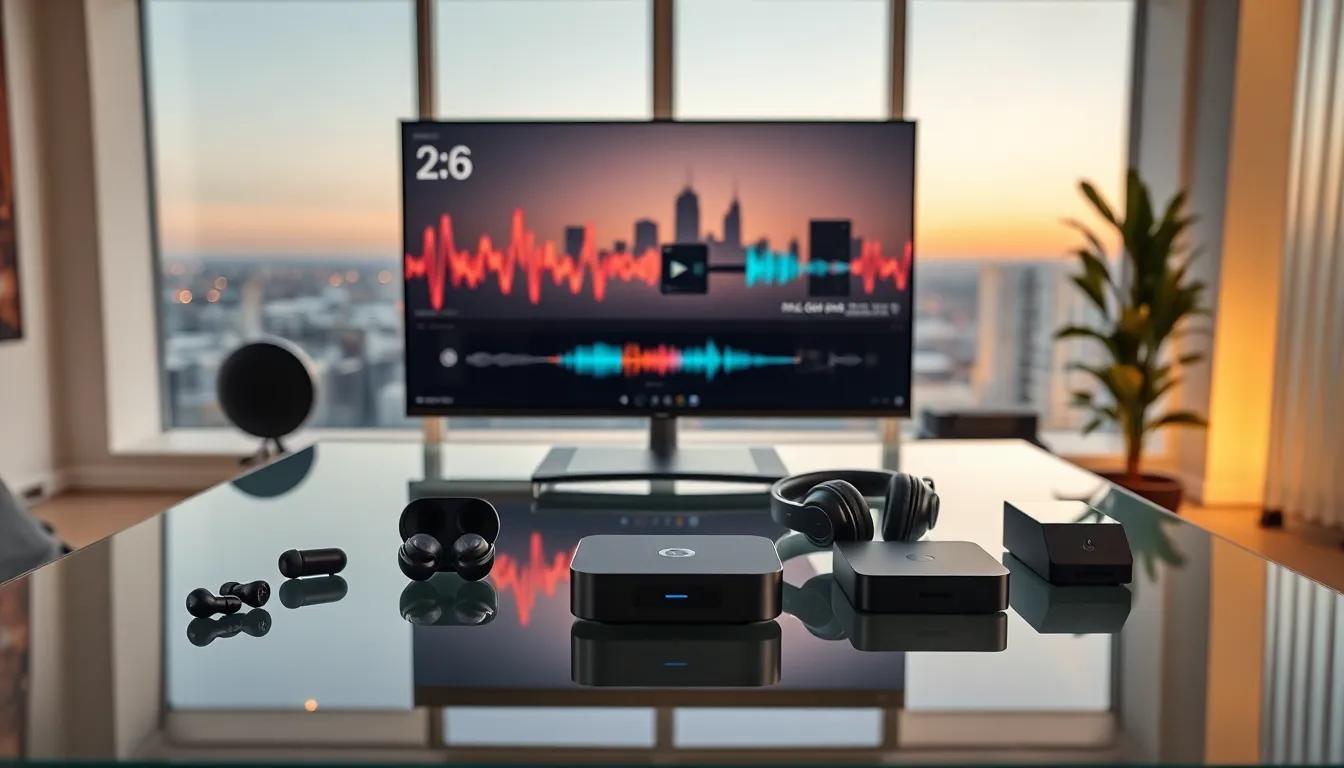
Top audio technology has changed how people listen to music, watch movies, and communicate. From wireless earbuds that deliver studio-quality sound to AI systems that optimize audio in real time, the industry continues to push boundaries. These advances aren’t just for audiophiles anymore, they’re showing up in everyday devices that millions of people use.
This article covers the most significant developments in audio technology today. Readers will learn about spatial audio, wireless innovations, AI-powered enhancements, and high-resolution standards that define modern sound experiences.
Table of Contents
ToggleKey Takeaways
- Top audio technology now delivers spatial audio experiences that create 3D soundscapes for music, gaming, and video conferencing.
- Bluetooth 5.3 and advanced codecs like aptX Lossless have made wireless audio nearly indistinguishable from wired connections.
- AI-powered features such as adaptive noise cancellation and voice isolation have become standard in modern earbuds and headphones.
- High-resolution audio streaming is now mainstream, with services like Apple Music and Tidal offering millions of lossless tracks at no extra cost.
- True wireless earbuds dominate the market, offering 8-10 hours of playback with premium features once exclusive to over-ear headphones.
- Personalized sound profiles powered by AI can analyze your hearing and customize audio output for a better listening experience.
Spatial Audio and Immersive Listening
Spatial audio represents one of the most exciting shifts in top audio technology. This technology creates a three-dimensional sound field around the listener. Instead of hearing music or dialogue from left and right channels only, users experience sound from above, below, and all around them.
Apple introduced Spatial Audio with Dolby Atmos support in 2021, and competitors quickly followed. Sony’s 360 Reality Audio offers a similar experience, placing individual sounds in a virtual sphere around the listener’s head. Both systems use head tracking to adjust the audio as users move, keeping the sound anchored to its source.
The benefits extend beyond entertainment. Gaming has embraced spatial audio to help players locate enemies and environmental cues with precision. Video conferencing platforms now use spatial positioning to make virtual meetings feel more natural, each participant’s voice comes from a distinct location, mimicking a real conference room.
Content creators have responded to this shift. Major streaming services like Apple Music, Tidal, and Amazon Music now offer thousands of tracks mixed in spatial formats. Movie studios release more titles with Atmos soundtracks. This growing library makes spatial audio increasingly practical for everyday listeners, not just early adopters.
The hardware requirements have also dropped. Many mid-range headphones and earbuds now support spatial audio processing. Some smartphones handle the computational work themselves, making immersive listening accessible without expensive equipment.
Advancements in Wireless Audio
Wireless audio technology has improved dramatically over the past five years. Top audio technology brands have solved many problems that once made Bluetooth audio inferior to wired connections.
Bluetooth 5.3 and newer versions deliver lower latency and better range than previous standards. Users can now watch videos without noticeable audio delay. The connection stays stable at greater distances from the source device.
Codec development has driven much of this progress. aptX Lossless, LDAC, and LC3 codecs transmit higher-quality audio streams over Bluetooth. Some systems achieve bit rates approaching CD quality. Apple’s AAC implementation has also improved, offering better performance on iOS devices.
Battery technology keeps pace with these demands. Premium wireless earbuds now deliver 8-10 hours of playback on a single charge. Charging cases extend total listening time to 30-40 hours. Fast charging features provide several hours of use from just a few minutes of charging.
True wireless earbuds have become the dominant form factor. They’ve largely replaced wired earphones for most consumers. The best models offer active noise cancellation, transparency modes, and customizable sound profiles, features once reserved for over-ear headphones.
Wireless speakers have benefited from these advances too. Multi-room audio systems stream synchronized music throughout homes without complicated wiring. Wi-Fi-based systems like Sonos and Apple AirPlay 2 deliver lossless audio quality that Bluetooth cannot match.
AI-Powered Sound Enhancement
Artificial intelligence has become central to top audio technology. Machine learning algorithms now handle tasks that once required expensive hardware or professional expertise.
Adaptive noise cancellation uses AI to analyze ambient sound and generate precise anti-noise signals. Modern systems learn from usage patterns and adjust their behavior automatically. Sony’s WH-1000XM5 headphones, for example, recognize common environments and apply appropriate settings without user input.
AI also improves audio quality in real time. Phones and earbuds can upscale compressed audio files, filling in frequencies lost during compression. These algorithms analyze the source material and predict what the original recording likely contained.
Voice isolation technology separates speech from background noise during calls. This feature has become standard in most wireless earbuds. The AI identifies human voice patterns and suppresses everything else, making calls clearer even in noisy environments.
Personalized sound profiles represent another AI application. Apps analyze users’ hearing through brief tests, then adjust equalization to compensate for individual hearing differences. This customization makes audio more enjoyable and can even help those with mild hearing loss.
Content recommendation systems use AI to analyze listening habits and suggest new music. Streaming services build detailed profiles based on tempo, genre, mood, and even specific audio characteristics that users prefer.
High-Resolution Audio Standards
High-resolution audio has moved from niche audiophile territory into mainstream products. Top audio technology now routinely supports formats that exceed CD quality.
The industry defines high-resolution audio as anything beyond 16-bit/44.1kHz, the CD standard. Common hi-res formats include 24-bit/96kHz and 24-bit/192kHz. These specifications capture more detail and dynamic range than standard formats.
Streaming services have embraced hi-res audio. Apple Music, Amazon Music, Qobuz, and Tidal offer millions of tracks in lossless and high-resolution formats. Many services include these options at no extra cost, removing the price barrier that once limited adoption.
Hardware support has expanded accordingly. Most flagship smartphones include DACs (digital-to-analog converters) capable of decoding hi-res files. Dedicated portable players from brands like Astell&Kern and FiiO cater to enthusiasts who want maximum quality.
The debate about audible differences continues. Some listeners report hearing clear improvements with hi-res audio. Others struggle to distinguish it from CD quality in blind tests. The consensus suggests that source quality and mastering matter more than sample rate alone.
Lossless formats like FLAC and ALAC preserve every detail from the original recording. They require more storage and bandwidth than compressed formats like MP3 or AAC. But, faster internet speeds and larger storage capacities have made this tradeoff acceptable for many users.